
A successful English teaching career in Hong Kong takes more than engaging activities and prepared materials—it demands a dynamic classroom power-duo. Whether you are stepping into a primary school, secondary school, or kindergarten, sharing a classroom with a Local English Teacher (LET) requires a strong, collaborative working partnership.
While aligning different teaching styles takes intentional coordination, the goal of English teaching in Hong Kong schools is not to teach identically. It is about leveraging every Native English teacher (NET) in Hong Kong alongside local teachers so together they contribute their unique strengths and take shared responsibility for student success.
Under Education Bureau (EDB) NET Grant, building a strong working partnership is central to driving student success. But what does that synergy actually look like in everyday classroom practice? More importantly, how can NETs and LETs align their different strengths to build equal authority and shared ownership? Here are 4 golden rules to elevate your co-teaching practice!
Table of Contents
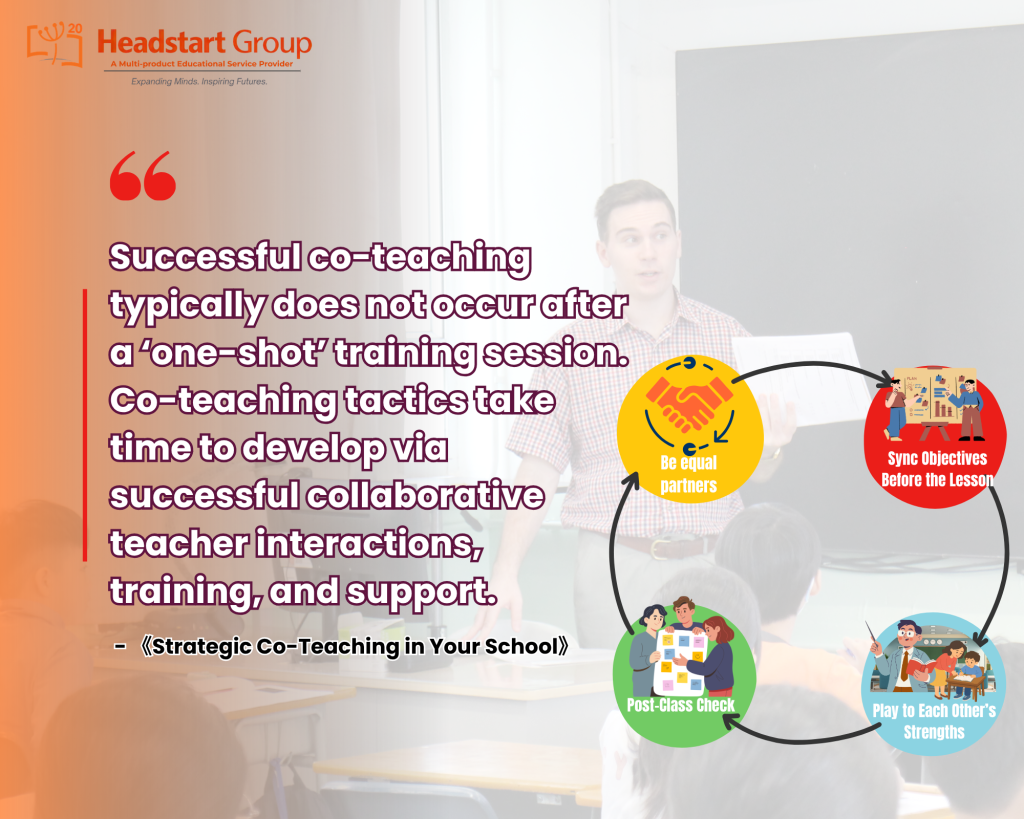
Rule #1: Be Equal Partners—Avoid the “Teacher and Assistant” Trap
involves far more than simply co-existing in a classroom—it requires establishing an authentic co-teaching dynamic. When a teacher systematically leads while the other is relegated to peripheral duties like distributing worksheets, the partnership becomes unbalanced. Consequently, students cease to view both teachers as equal instructional authorities.
To cultivate genuine collaboration and mutual professional respect, both teachers must execute visible, high-impact instructional roles in every lesson:
- Interactive Tag-Team Delivery: Have one teacher lead a story or explanation while the other models’ questions, sentence structures, or vocabulary on the board.
- Active Co-Facilitation: Rather than assigning one teacher to passive observation, both teachers should actively circulate during tasks to differentiate support, assess student performance, and guide small-group interactions.
- Rotational Leadership: Design lesson sequences where instructional lead shifts fluidly depending on the activity, rather than maintaining a static lead-and-support hierarchy throughout the academic term.
Put it into practice
- Use shared language: “Today, we are going to help you…”
- Agree on classroom expectations and reinforce them together.
- Give both teachers opportunities to explain, demonstrate and provide feedback.
- Distribute classroom management and administrative responsibilities equitably.
For an English teacher in Hong Kong, a useful question to ask is: “Are we both contributing to the learning, or have we slipped into fixed roles?”
Rule #2: Sync Objectives Before Stepping Into the Lesson
A lesson plan may describe the activities clearly without explaining how two teachers will deliver them together.
That is why a pre-lesson conversation matters. Use it to confirm the learning goal, clarify responsibilities and identify any adjustments needed for the class. Treat this check-in as a follow-up to shared planning, rather than a substitute for it.
Cover these 5 essential check-in questions:
- Objective: What is our primary learning target for this lesson?
- Instruction: Who is introducing and modeling each activity?
- Resources: Who will manage the board, slides, and learning props?
- Differentiation: How will we support students needing extra assistance or greater challenge?
- Flexibility: What will we adapt or shorten if time runs short?
Before a storytelling lesson, both teachers could agree on who reads, who asks questions and how to support students who need extra help, so they enter the classroom with a shared plan.
Planning the small details matters, too. Who distributes the menus? How will pairs be formed? What should early finishers do?
Rule #3: Play to Each Other’s Strengths—Without Creating Fixed Roles
A productive partnership makes full use of what each English language teacher in Hong Kong brings to the table. That might include storytelling, phonics, curriculum planning, assessment, classroom management or designing speaking activities.
However, strengths should be discovered, not assumed.
Once these strengths are identified, the LET might anchor the structured language rules, while the NET brings those grammar points to life through interactive games and speaking practice, allowing their expertise to complement each other.
Ask each other during planning:
- Which parts of this lesson are we each most confident teaching?
- What do we know about this class that could improve the activity?
- Is there a strategy one of us could model for the other?
- Could we swap roles in a future lesson to develop our skills?
The goal is not simply to divide the workload. It is to combine ideas, learn from one another and create something stronger together.
Rule #4: Foster Continuous Growth Through Post-Class Check
Your partnership doesn’t end when the bell rings. A brief debrief gives both teachers a chance to compare observations, recognise what worked and agree on a practical adjustment. Keep the discussion focused on students’ learning rather than on judging a colleague’s performance.
Keep the conversation focused entirely on student learning rather than critiquing individual performance:
Start with:
-> “What did we notice, and what could we try next time?”
Instead of saying, “Your instructions were too long,” try:
-> “Several groups needed the instructions repeated. Next time, shall we demonstrate the task first and leave the steps on the board?”
Rather than saying, “The students were not engaged,” try:
-> “Some students spoke confidently in pairs but stayed quiet during whole-class questions. Could we give them rehearsal time before inviting answers?”
Use the “Keep, Change, Try” approach
Prompt | Question to discuss |
Keep | What helped students understand or participate? |
Change | What made the lesson harder to follow? |
Try | What is one adjustment we can make next time? |
Not every lesson needs a lengthy review. One shared observation and one agreed next step can keep reflection manageable.
Summary
At its core, a successful co-teaching partnership is far more than a practical arrangement for managing a classroom—it is a transformative professional relationship that shapes the entire learning culture of a school. When NETs and LETs unite their unique perspectives, expertise, and passion, they create an environment where cultural walls break down, confidence thrives, and language learning truly comes alive.
By grounding your daily practice in equal respect, deliberate alignment, and constant shared growth, you aren’t just delivering lessons—you are laying the foundation for an inspiring, world-class educational experience that students will carry with them for a lifetime.
Ready to Launch Your English Teaching Job in HK?
Thousands of NETs have started their Hong Kong chapter this way. As a trusted NET recruitment service supplier, Headstart connects talented teachers with rewarding roles across kindergartens, primary, and secondary schools throughout Hong Kong.
Ready for your Hong Kong teaching journey?
Click below to find out how Headstart Group can help make your dream come true — spots filled up fast! 🚀